The Classification Problem
Functional beverages occupy a unique and often confusing regulatory space in the United States. Depending on their ingredients, claims, and how they're marketed, the FDA may classify your beverage as a conventional food, a dietary supplement, or even a drug. This classification determines every aspect of your labeling requirements — and getting it wrong can result in FDA warning letters, import holds, or forced product recalls.
How the FDA Classifies Beverages
Conventional Food Beverages
Most beverages — juices, teas, waters, sodas, and many functional drinks — are regulated as conventional foods. These products require:
- Nutrition Facts Panel: Standard format per 21 CFR 101.9
- Ingredient List: All ingredients in descending order of predominance by weight
- Allergen Declaration: Big 9 allergens must be declared
- Standard Serving Sizes: Must use FDA's Reference Amounts Customarily Consumed (RACC)
Dietary Supplement Beverages
If your beverage is marketed as a dietary supplement and contains dietary ingredients (vitamins, minerals, herbs, amino acids), it may be classified as a liquid dietary supplement. These require:
- Supplement Facts Panel: Different format from Nutrition Facts
- "Dietary Supplement" Statement: Must appear on the label
- Structure/Function Claim Disclaimer: If claims are made
- Suggested Use Directions: Including serving amount
Common Functional Beverage Categories and Their Classification
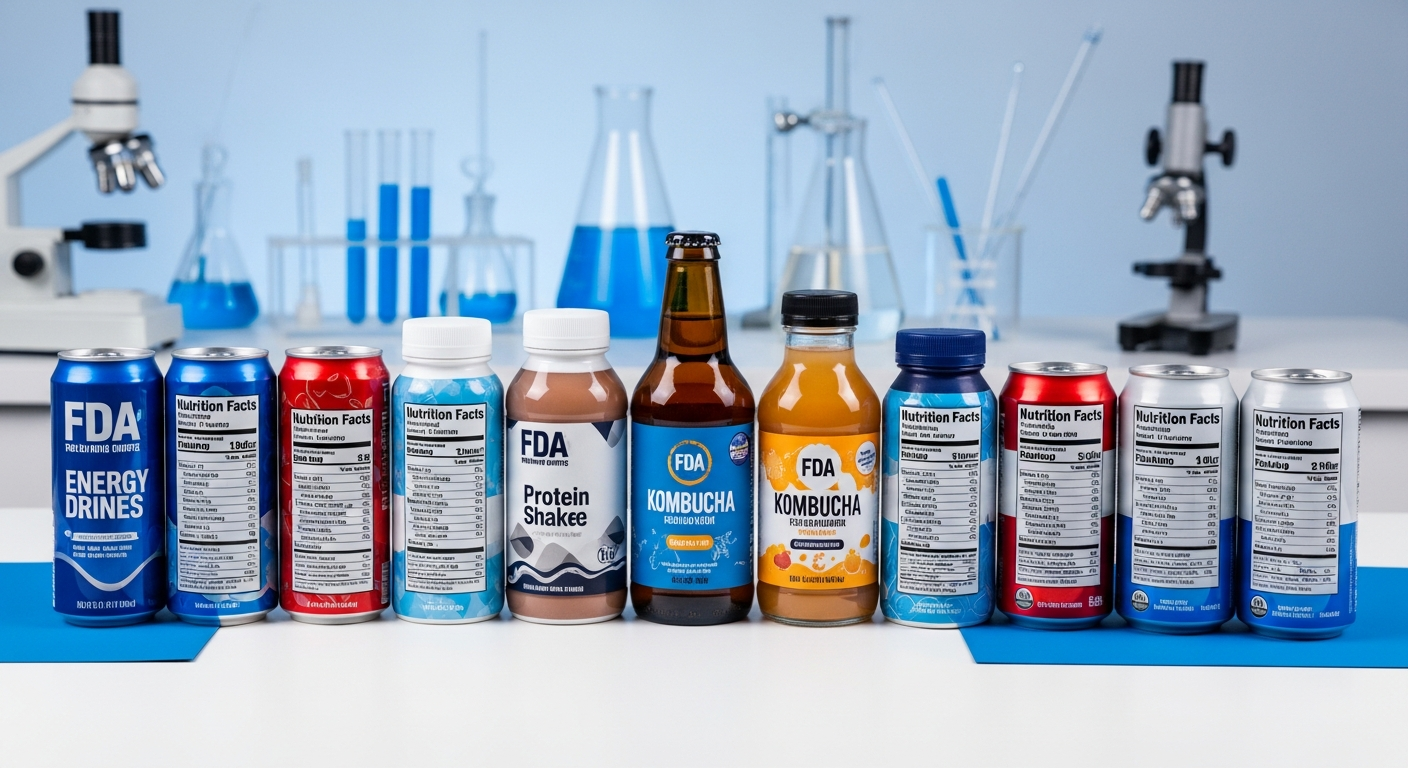
- Kombucha: Generally regulated as a conventional food; must comply with alcohol labeling if above 0.5% ABV
- Energy Drinks: Conventional food if marketed as a beverage; supplement if marketed as a dietary supplement (e.g., 5-Hour Energy shots)
- Protein Shakes/RTDs: Usually conventional food with Nutrition Facts, but may be a supplement if marketed primarily for protein supplementation
- Adaptogenic Drinks: Classification depends on ingredients and claims — ashwagandha or reishi mushroom drinks often lean toward supplement classification
- Collagen Waters: Gray area — could be either food or supplement depending on marketing
- CBD Beverages: Currently not permitted as either a food additive or dietary ingredient at the federal level (state laws vary)
Label Requirements Comparison
Nutrition Facts (Conventional Food)
- Calories, total fat, sodium, total carbs, protein, and other mandatory nutrients
- Serving size based on RACC values
- % Daily Value based on a 2,000-calorie diet
- Added sugars declaration (mandatory since 2020)
- Updated label format with bold calorie count
Supplement Facts (Dietary Supplement)
- All dietary ingredients listed with amounts per serving
- % Daily Value where established
- Proprietary blends listed with total weight
- "Other ingredients" section for non-dietary ingredients
- Manufacturer/distributor name and address
Critical Labeling Mistakes to Avoid
- Using the wrong panel type: A Supplement Facts panel on a conventional food (or vice versa) is a major violation
- Inconsistent marketing: Marketing your product as a "beverage" but using a Supplement Facts panel creates a classification conflict
- Unauthorized health claims: Only FDA-authorized health claims can appear on conventional food labels; qualified health claims and structure/function claims have different rules
- Missing added sugars: The updated Nutrition Facts label requires added sugars declaration — many international brands miss this
- Incorrect serving sizes: Conventional food servings must follow RACC; supplement servings are set by the manufacturer
Get Your Beverage Labels Reviewed
The food-vs-supplement classification for functional beverages is one of the trickiest areas of FDA compliance. A single wrong decision about classification can cascade into dozens of labeling errors. NPI's FDA Label Review service helps international beverage brands determine the correct classification for each product and ensures every label element meets U.S. requirements. Your first review is free with the Blueprint program.
 Distribution Strategy